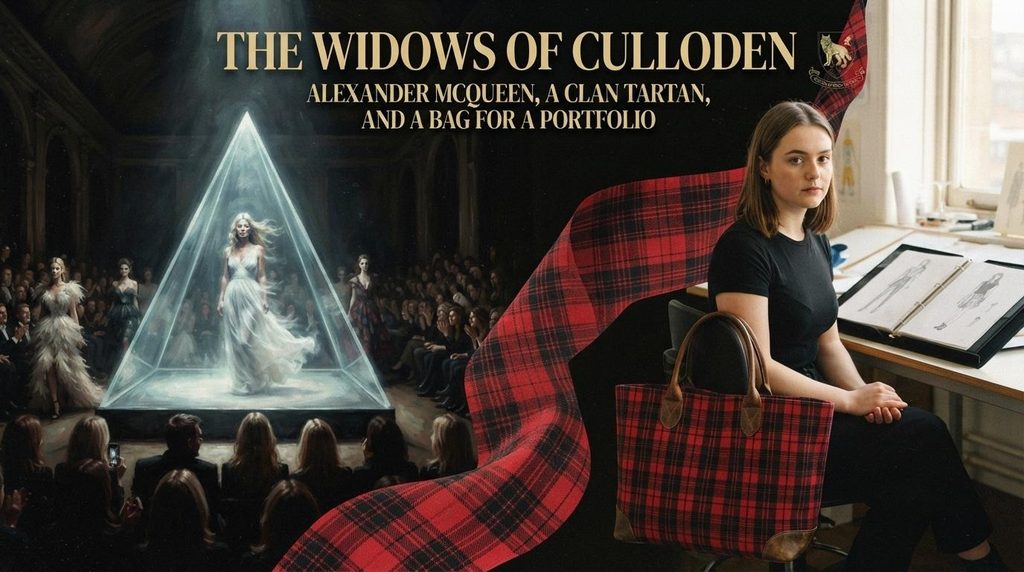
The story of the MacQueen tartan is inseparable from Alexander McQueen’s vision of Scottish history, mourning and Highland identity. In March 2006, in a great darkened hall in Paris, the lights went down on the autumn collection of a London designer, and a woman appeared inside a glass pyramid at the end of the runway.
She was Kate Moss, or the ghost of her: a life-size image in a drifting white dress, turning slowly in the dark, dissolving and reforming, her hair moving in a wind that was not there. The audience, who had seen everything, sat in silence. Some of them cried. When she vanished, the applause went on for a long time.
The collection was called Widows of Culloden. Its designer was Lee Alexander McQueen, and for the previous twenty minutes his models had walked out in gowns of grey tulle and gamebird feathers, in tailored jackets cut like a Highland officer’s coat, in headdresses made of antlers, and, over and over, in a tartan of red, black and yellow that most of the audience had never seen before. It was his own. It was the MacQueen.
The tailor’s apprentice
McQueen was born in 1969 in Lewisham, the youngest of six children of a London taxi driver. The family was of Scottish descent, from the Hebrides, and he grew up in the East End with the name and very little else to connect him to it. He left school at sixteen and went to work as an apprentice at Anderson & Sheppard, the Savile Row tailors, where he learned to cut a jacket the old way, and then at Gieves & Hawkes, who made uniforms. That training never left him. However wild his shows became, the tailoring underneath was faultless, because a man who has cut coats for the Prince of Wales does not forget how.
He went to Central Saint Martins, and his graduate collection in 1992 was bought in its entirety by the stylist Isabella Blow, who became his champion. Within four years he was chief designer at Givenchy in Paris. Within ten he was one of the two or three most influential designers in the world, famous for shows that were part theatre, part nightmare, and always beautiful.
Scotland ran through the work like a thread. In 1995 he showed a collection called Highland Rape, with models in torn lace and tartan, ravaged and staggering, which the press took for a provocation about violence against women. McQueen said it was about the Clearances and the Jacobite defeat, about what England had done to the Highlands, and about his own family. Eleven years later, Widows of Culloden was the same story told with grief instead of anger. The women on the runway were the widows of the men who died on the moor in April 1746, dressed in mourning and in the tartan of their dead.
He died in February 2010, aged forty. His ashes were carried to Skye, the island his family came from, and scattered at Kilmuir, where Flora MacDonald is buried.
Clan Revan
The tartan he made famous is older than him and younger than it looks.
The MacQueens are a small clan of the Central Highlands, one of the tribes of Clan Chattan, the great confederation of the Cat. Their own account, preserved in the tartan archives, is that around 1410 a MacDonald bride was brought to Moy to marry the chief of Mackintosh, and that among the kinsmen who escorted her was Revan MacMulmor MacAngus MacQueen. He stayed, took protection from Clan Chattan, and his descendants were called the Clan Revan after him. Their lands were at Corrybrough, near Tomatin, in Strathdearn. A separate branch, the MacQueens of Skye, were hereditary bards and clergy to the MacDonalds of Sleat, and it is from this island line that the designer’s family descended. The clan crest is a wolf, and the motto is Constant and faithful.
The tartan first appears in the Vestiarium Scoticum of 1842, the glorious fraud that gave so many families their cloth, and the archives note, as they do for every entry from that source, that it is unreliable. The pattern itself is a bold and simple one: a strong red ground crossed by wide bands of black, with a single fine line of yellow at the pivot. It resembles the Wallace, which has the same three colours, and the archives suggest it may descend from a combination of the MacDonald and Mackintosh setts, the two families in the story of the bride.
There is one more thing about it worth knowing. Red and black with a yellow line is, at a glance, close to the Wallace, and the two are often confused in shops. The proportions are different, the MacQueen’s black bands being far heavier, so that the red reads as the pattern and the black as the ground. Held beside each other they are not alike at all. Held apart, a great many people cannot tell them, which is one reason the designer’s use of it was such a gift to the clan: for the first time, people looked closely.
It was a little-known tartan until a taxi driver’s son put it on a runway. Retailers now offer MacQueen tartan made to order as kilts, skirts, waistcoats, scarves and ties, or by the yard, in Modern and Ancient colours, and the demand for it among people who have never heard of Corrybrough is entirely his doing.
Glasgow School of Art, a Thursday in March
Rhona MacQueen is twenty-two and in her final year of fashion design at Glasgow School of Art. She has been told twice that she has the right name for the job and finds it less funny each time. She has also, since she was fifteen, been able to describe every look in Widows of Culloden from memory.
This morning she has a portfolio review with two visiting designers from London, and she has to get thirty sheets of A3 drawings, fabric swatches, a toile, a laptop and her lunch across the city on the subway without any of it bending.
Fashion students carry their lives in bags, and the bags are a statement, and Rhona’s statement is on the strap of a tote. She had gone looking for something in the family tartan and found that what the Highland outfitters file as kilt bags is mostly totes and weekenders. The range at Scottish Kilt is described as tartan tote bags in woven cloth and heavy canvas, with full-grain leather handles and base corners, which is exactly where a loaded tote takes all of its wear. That sentence, she said, was the first honest thing she had read about a bag in years.
She bought the big canvas one, in the MacQueen: red and black with the thread of yellow, leather at the handles and the four corners, a button flap across the top. It is wide enough to take A3 flat. It has been to every lecture, every crit and every club since October, and the corners are scuffed and the tartan is not. She had considered the quilted one, and the weekender with the zip, and settled on the plain canvas because it lies flat under a chair and because, as she put it, the tartan is the design and the bag should shut up.
The two designers from London look at her sheets, which are good, and at her toile, which is better, and then the older of the two looks at the bag on the floor.
“That’s the McQueen tartan.”
“MacQueen. It’s my name.”
“Widows?”
“Widows, Highland Rape, everything. I know it’s obvious. I know everyone with a Scottish name wants to be him.” She picks up the bag and puts it on the table. “But he was a Savile Row apprentice before he was anything, and his family were bards on Skye, and the tartan’s from a book that’s basically a forgery, and he put it on Kate Moss as a ghost and made a room full of the most cynical people in the world cry. If I get to be a tenth of that, I’ll take it.”
The designer, who was in the room in Paris in 2006, does not say so. She looks at the tartan a while longer.
“Constant and faithful,” she says. “That’s the motto, isn’t it. I looked it up once.” She pushes the toile back across the table. “The shoulder’s too heavy. Take a centimetre out. Otherwise it’s very good.”
The cloth of the dead
Alexander McQueen took a small clan’s tartan out of a fraudulent Victorian book and gave it to the widows of a battle that ended the world his ancestors came from. It was a piece of theatre and a piece of mourning, and it was also, underneath, a beautifully cut jacket, because he had been trained by men who cut for kings.
The tartan is red and black with one thread of gold, and it looks well on a canvas bag with leather corners, going across Glasgow on the subway in the hands of a girl with the right name and thirty sheets of drawings. He would have looked at the drawings first. Then he would have told her about the shoulder.