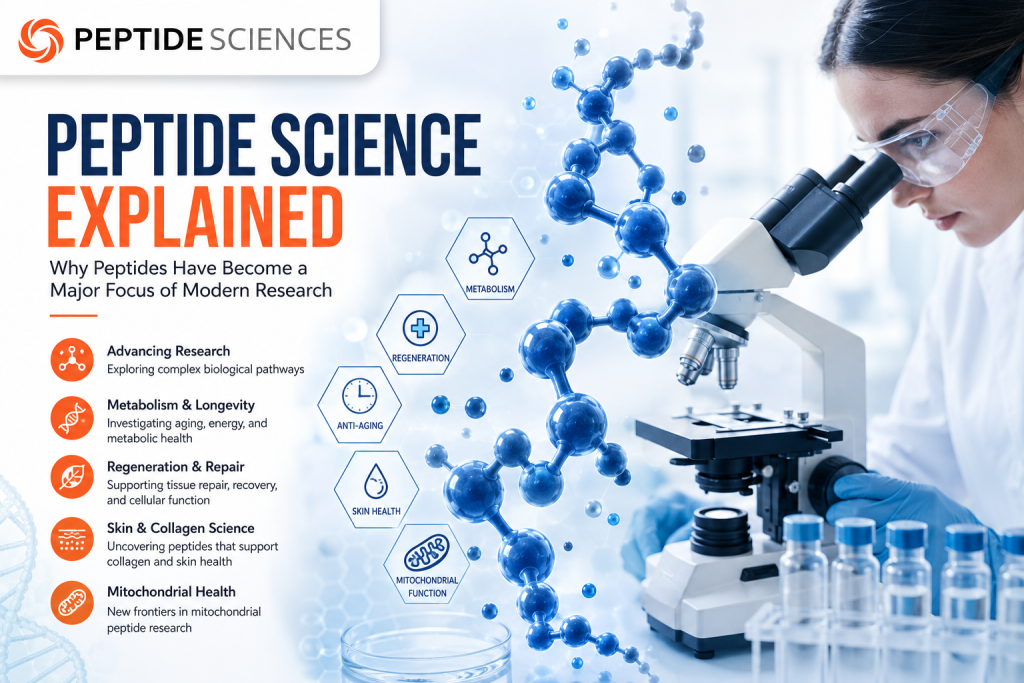
Modern biomedical research is increasingly focused on understanding how cells communicate, adapt, repair themselves, and respond to changes in their environment. At the center of many of these processes are peptides—small chains of amino acids that can function as highly specific biological messengers. Mounjaro Malaysia has also drawn growing interest in this field, particularly because its active ingredient, tirzepatide, is a peptide-based medicine that acts on specific metabolic signaling pathways.
Over the past decade, Peptide Science has expanded rapidly from a specialized area of biochemistry into a major field of investigation spanning metabolism, obesity, tissue regeneration, inflammation, skin biology, growth hormone signaling, mitochondrial function, and cellular aging.
The growing interest is not accidental. Peptides occupy a unique position between small molecules and larger proteins. Their structural diversity and ability to interact selectively with biological targets make them valuable tools for studying complex physiological pathways.
So why have peptides become such an important focus of modern research?
What Makes Peptides Scientifically Important?
Peptides are chains of amino acids connected by peptide bonds. While generally smaller than proteins, they can have remarkably specific biological functions.
Naturally occurring peptides are found throughout the human body and other living organisms. They can function as hormones, neurotransmitters, growth factors, immune mediators, antimicrobial molecules, and regulators of cellular communication.
Insulin, for example, is a peptide hormone essential to glucose regulation. Other peptide signaling systems influence appetite, inflammation, tissue repair, reproduction, growth, stress responses, and energy balance.
This ability to participate in precise biological signaling makes peptides particularly interesting to researchers. By studying a peptide and its interaction with specific receptors or molecular pathways, scientists can gain insight into how complex physiological processes are controlled.
Advances in peptide synthesis, purification, analytical chemistry, computational biology, and laboratory technology have further accelerated this field, allowing increasingly complex molecules to be produced and investigated.
Metabolic Research and the Rise of Peptide-Based Science
Few areas demonstrate the growing importance of peptides more clearly than metabolic research.
Obesity, diabetes, insulin resistance, and related metabolic disorders have become major global health challenges. This has intensified scientific interest in the hormones and signaling pathways that regulate hunger, satiety, glucose metabolism, insulin secretion, gastric emptying, and energy expenditure.
GLP-1-related research has become especially prominent. Semaglutide acts through the GLP-1 receptor, while tirzepatide targets both GIP and GLP-1 receptor pathways.
Retatrutide extends this concept further by acting through GIP, GLP-1, and glucagon receptors.
Researchers are also investigating compounds such as cagrilintide, which is related to amylin signaling, as well as AOD-9604, MOTS-c, and other compounds associated with fat metabolism, mitochondrial activity, and energy balance.
These developments illustrate an important direction in modern peptide science: researchers are increasingly investigating multiple interconnected pathways rather than viewing metabolism through a single biological target.
Regenerative Biology and Tissue-Repair Research
Another rapidly expanding area involves peptides associated with tissue repair and regeneration.
The human body relies on complex interactions between blood vessels, immune cells, extracellular matrix components, growth factors, and signaling molecules to repair damaged tissue. Researchers are investigating whether specific peptides can help clarify these mechanisms.
BPC-157, for example, has been examined primarily in preclinical research involving gastrointestinal tissues, tendons, ligaments, muscles, angiogenesis, and inflammatory pathways.
TB-500 is associated with thymosin beta-4-related research and has attracted interest because of its relationship with actin regulation, cellular migration, angiogenesis, and tissue repair.
KPV, a short tripeptide derived from alpha-melanocyte-stimulating hormone, is investigated for its potential relationship with inflammatory signaling and epithelial tissues.
These compounds remain at different stages of scientific investigation, and preclinical findings should not be treated as established evidence of human safety or effectiveness. Nevertheless, their study is helping researchers explore the molecular processes involved in inflammation, recovery, and regeneration.
Peptides and the Biology of Aging
Aging was once viewed primarily as an unavoidable consequence of time. Modern science increasingly approaches it as a collection of interconnected biological processes.
Researchers now investigate mitochondrial dysfunction, cellular senescence, genomic instability, altered intercellular communication, oxidative stress, changes in protein regulation, and declining regenerative capacity.
This has created growing interest in peptides associated with longevity and cellular aging.
Epitalon has been investigated in relation to cellular aging and telomere biology. GHK-Cu has attracted attention for its relationship with tissue remodeling, wound healing, collagen synthesis, and gene expression. Mitochondrial-derived peptides such as MOTS-c and Humanin are being studied for their possible roles in metabolic regulation, cellular stress responses, and age-associated biological changes.
The scientific challenge is considerable. Aging is not controlled by one molecule or pathway, and no single peptide can explain the enormous complexity of the process.
However, peptide research provides scientists with new tools for investigating individual mechanisms that contribute to how cells and tissues change over time.
Skin Science, Collagen, and Cellular Repair
Skin biology represents another important frontier in peptide research.
Skin is a complex organ containing collagen, elastin, blood vessels, immune cells, fibroblasts, and an extracellular matrix that provides structural support. With age and
environmental exposure, collagen production may decline while oxidative stress and other forms of damage accumulate.
Researchers study peptides to understand how these processes may be influenced at the molecular level.
GHK-Cu is one of the most widely discussed peptides in skin and tissue research. This naturally occurring copper-binding tripeptide has been investigated for its association with collagen synthesis, extracellular matrix remodeling, wound repair, inflammatory signaling, and antioxidant processes.
Other cosmetic and research peptides are studied for their potential effects on fibroblast activity, collagen-related pathways, skin structure, and cellular communication.
The growth of peptide-based skin research demonstrates how peptide science increasingly connects molecular biology with dermatology, regenerative science, and aging research.
Growth Hormone Pathways and Body-Composition Research
Growth hormone signaling has been an established focus of peptide research for many years.
Growth Hormone-Releasing Hormone analogs, or GHRH analogs, interact with pathways involved in stimulating growth hormone secretion from the pituitary gland. Examples include CJC-1295, Sermorelin, and Tesamorelin.
Growth Hormone-Releasing Peptides, or GHRPs, generally act through the growth hormone secretagogue receptor associated with ghrelin signaling. Examples include Ipamorelin, GHRP-2, GHRP-6, and Hexarelin.
These compounds are investigated in relation to growth hormone release, IGF-1 signaling, metabolism, recovery, body composition, and other physiological processes.
Importantly, these peptides are not interchangeable. Differences in receptor activity, molecular structure, duration of action, and biological effects make careful scientific classification essential.
Mitochondrial Peptides: An Emerging Research Frontier
One of the most fascinating developments in modern peptide science is the discovery and investigation of mitochondrial-derived peptides.
Mitochondria are widely known for producing cellular energy, but they also participate in metabolic signaling, oxidative stress responses, inflammation, apoptosis, and cellular adaptation.
MOTS-c and Humanin are two prominent examples of mitochondrial-derived peptides currently being investigated.
MOTS-c has attracted attention for its relationship with metabolic homeostasis, glucose utilization, cellular stress, and mitochondrial communication. Humanin is studied in connection with cellular protection, stress responses, metabolism, and age-associated processes.
This field is still developing, but it challenges the older view of mitochondria as simple cellular powerhouses. Instead, mitochondria are increasingly recognized as active signaling centers capable of influencing broader biological processes.
Why Peptide Science Will Continue to Grow
The rise of peptide science reflects a broader transformation in modern biomedical research. Scientists increasingly seek precise ways to understand biological communication at the molecular level, and peptides provide valuable tools for doing so.
Advances in artificial intelligence, computational modeling, automated synthesis, HPLC, Mass Spectrometry, and structural biology are making it possible to discover, produce, and evaluate peptides with increasing sophistication.
The future may bring major developments in metabolic science, regenerative biology, targeted drug delivery, antimicrobial research, cancer biology, neuroscience, skin regeneration, mitochondrial function, and longevity.
Yet scientific excitement must remain balanced with evidence. Research findings from cells or animals cannot automatically be translated into conclusions about humans, and the quality, identity, purity, and stability of research compounds remain fundamental.
Peptides have become a major focus of modern research because they sit at the heart of biological communication. By studying these small but powerful molecules, scientists are gaining new insight into how organisms regulate metabolism, repair tissues, respond to stress, age, and maintain cellular function.
As technology advances, peptide science is likely to remain one of the most dynamic and rapidly evolving areas of modern biological research.