The internet makes it possible to discover new websites, marketplaces, and online services within seconds. However, convenience also creates risk. A domain can look professional while providing very little reliable information about who operates it, how user data is handled, or whether its reputation can be independently verified. For that reason, unfamiliar websites deserve careful examination before visitors create accounts, submit information, download files, or make payments.
Stashpatrick.gl is one of the domain names that may appear in searches connected with terms such as Stashpatrick Shop Security, Stashpatrick CC Review, Patrickstash New Domain, Stash Patrick Market, and Patrick Stash Market. These search phrases can create curiosity, but search visibility should never be treated as proof that a website is legitimate or safe.
This Stashpatrick.gl review takes an educational approach. Rather than making unsupported claims about the people behind a particular domain, it explains the security, reputation, privacy, and technical signals users should examine before interacting with an unfamiliar website.
Why Domain Safety Should Be Checked First
A domain name is often the first element users notice, but it reveals only a small part of a website’s trustworthiness. A polished name, attractive interface, or familiar branding can create an impression of legitimacy without providing meaningful evidence.
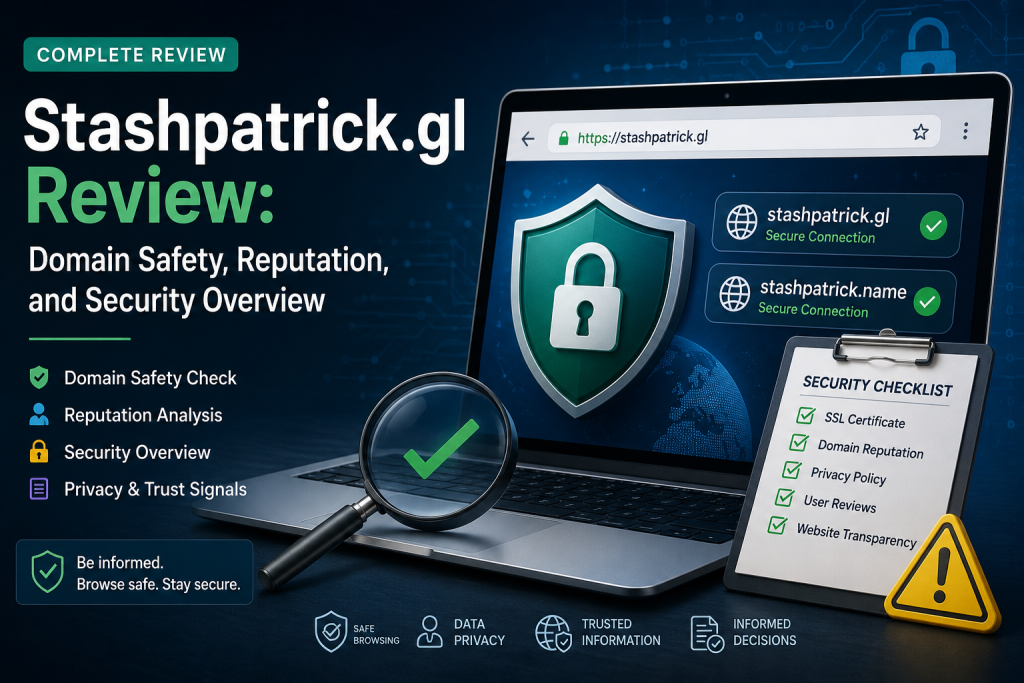
Before trusting Stashpatrick.gl or any unfamiliar domain, visitors should investigate several independent signals. These include the site’s connection security, domain history, contact information, privacy disclosures, external reputation, and consistency of its identity across the web.
The objective is not simply to decide whether a page “looks safe.” A better question is whether there is enough verifiable information to justify interacting with it.
A cautious review normally considers:
- Whether the connection uses HTTPS correctly
- Whether browser security warnings appear
- How established the domain appears to be
- Whether ownership and contact details are transparent
- Whether privacy and service policies are available
- Whether independent sources discuss the domain
- Whether the site requests unusual personal or financial information
No single factor provides a complete answer. Trust is stronger when several independent signals point in the same direction.
Understanding Stashpatrick Shop Security
People searching for Stashpatrick Shop Security may be trying to understand the risks associated with a website or service carrying this name. The safest approach is to evaluate the domain technically and independently instead of relying on promotional descriptions.
HTTPS is an important starting point. When a website uses HTTPS properly, information transmitted between the visitor and the website is encrypted in transit. This makes interception more difficult. However, HTTPS alone does not establish that a business is trustworthy. Even deceptive websites can obtain valid security certificates.
Visitors should therefore examine the certificate together with other indicators. Unexpected redirects, repeated pop-ups, forced downloads, misleading buttons, unusual browser permission requests, or warnings from security software deserve attention.
A legitimate-looking interface cannot compensate for weak transparency or suspicious behavior.
What a Stashpatrick CC Review Should Examine
A useful Stashpatrick CC Review should focus on verifiable evidence rather than assumptions. Reviews of unfamiliar websites sometimes repeat claims from other pages without checking their original sources. This can create an artificial reputation that appears stronger than it really is.
Independent evaluation is more valuable. Readers should look for reviews from multiple unrelated sources and pay attention to the quality of the information being presented.
For example, a review is more useful when it explains why a domain receives a particular assessment. Evidence involving domain history, security scans, privacy practices, transparent business information, and documented user experiences is more informative than a simple rating without context.
Readers should also be cautious when many reviews use nearly identical wording. Repetition across websites does not necessarily mean independent confirmation.
Patrickstash New Domain and the Importance of Domain Changes
The phrase Patrickstash New Domain raises another important security issue: domain migration. Websites sometimes move to new domains for completely legitimate reasons, including rebranding, technical upgrades, regional expansion, or changes in hosting.
At the same time, frequent unexplained domain changes can make verification more difficult.
When a website claims to have moved, users should avoid trusting a new address merely because its name resembles an older one. Look for independent evidence connecting the two domains. Official announcements, consistent company information, verified profiles, and established communication channels can help demonstrate continuity.
A new domain should be assessed independently even when its branding appears familiar. Similar names can be registered by unrelated parties, which is why assumptions based on spelling alone are risky.
Reputation Signals Around Stash Patrick Market
Searches for Stash Patrick Market may return different types of pages, discussions, reviews, or references. Search results themselves should be interpreted carefully because ranking is not a security certification.
A website can rank for a keyword without being independently verified.
Reputation analysis should instead consider how long reliable information about the service has existed and whether trustworthy third parties have documented its activities. Users should distinguish between independent reporting, user-generated discussion, promotional content, and copied material.
The age of online references also matters. If virtually all mentions appear within a short period, there may be limited historical information available for evaluating the site’s reputation.
That does not automatically prove anything negative, but it increases uncertainty.
Evaluating Patrick Stash Market Claims
When researching Patrick Stash Market, users may encounter descriptions that make strong claims about reliability, privacy, availability, or service quality. Such statements should be treated as claims until they can be verified.
Trustworthy websites generally make it reasonably clear who operates the service, what users can expect, and what rules apply. Depending on the nature of the service, visitors should look for meaningful contact information, terms of service, privacy documentation, refund or dispute policies, and information about data handling.
Vague policies deserve closer examination, particularly when a website asks users to provide sensitive information.
Visitors should also avoid assuming that testimonials displayed directly on a website are independent evidence. External sources usually provide a more balanced foundation for reputation research.
Technical Checks for Stashpatrick.gl
Before interacting with Stashpatrick.gl, users can perform basic technical checks without creating an account or providing personal information.
Start by checking whether the browser reports a secure HTTPS connection. Pay attention to certificate errors and warnings. Modern browsers are designed to alert users when serious connection problems are detected, and those warnings should not be casually bypassed.
Domain history is another useful signal. Registration information may provide clues about when a domain was established and whether major changes have occurred. Privacy-protected registration is common and does not automatically indicate a problem, but limited ownership information means users may need to rely more heavily on other verification methods.
Security reputation services can also help identify whether a domain has previously been associated with malware, phishing, unwanted downloads, or other reported threats. Because automated tools can occasionally produce false positives or miss new threats, results should be compared rather than treated as absolute proof.
Comparing Stashpatrick.gl and Stashpatrick.name
Users who encounter both Stashpatrick.gl and Stashpatrick.name should not automatically assume that the domains have the same owner or operator.
Similar domain names can belong to the same organization, unrelated individuals, impersonators, or third parties. Verification should therefore focus on documented relationships rather than visual similarity.
Compare the domains carefully. Check whether they provide matching organizational details, policies, contact information, and verified announcements. Look at whether one domain officially references the other through a consistent and credible channel.
Redirects should also be examined cautiously. An unexpected redirect from one domain to another is not necessarily malicious, but visitors should understand where they are being sent before entering credentials or other information.
Privacy Risks Visitors Should Consider
Website safety is not limited to malware. Privacy is equally important, particularly when an unfamiliar service requests email addresses, phone numbers, identity information, payment details, cryptocurrency information, or account credentials.
Before submitting anything, determine why the information is needed and how the website says it will be stored or used.
A clear privacy policy should explain data collection in understandable language. Visitors should be cautious if the website requests substantially more information than appears necessary for its stated purpose.
Browser permissions matter too. Requests for notifications, location access, camera access, microphone access, or clipboard permissions should only be approved when there is an obvious and legitimate reason.
Warning Signs That Deserve Extra Attention
No individual warning sign automatically proves that a website is unsafe. However, several problems appearing together can justify greater caution.
Common signals include recently created domains combined with limited public history, unclear ownership, missing policies, aggressive redirects, suspicious downloads, unrealistic promises, and pressure to act immediately.
Users should be particularly careful when a website creates artificial urgency. Messages claiming that an opportunity will disappear within minutes can discourage thoughtful verification.
Likewise, requests to disable browser protections or antivirus software should be treated seriously. Security protections exist precisely to reduce exposure to potentially harmful content.
Safer Browsing Practices for Unfamiliar Domains
Users researching Stashpatrick.gl, Stashpatrick.name, or similarly named domains can reduce unnecessary exposure through basic browsing habits.
Keep the browser and operating system updated because security patches address known vulnerabilities. Use reputable security software where appropriate, and avoid downloading unknown executables or browser extensions from websites that have not been independently verified.
Unique passwords are equally important. Reusing the same password across multiple websites can turn one compromised account into a much larger problem. A password manager can help generate and store unique credentials.
Multi-factor authentication should be enabled on important accounts whenever available. This adds another barrier if a password is exposed.
Most importantly, do not provide sensitive personal or financial information simply to investigate whether a website is legitimate.
Building a Balanced View of Online Reputation
A responsible assessment of an unfamiliar domain requires more than positive or negative comments. Online reputation can be manipulated in both directions, which means evidence quality matters.
Look for patterns across independent sources. Consider when information was published, whether supporting evidence is provided, and whether the reviewer clearly distinguishes verified facts from personal opinion.
Search terms such as Stashpatrick Shop Security, Stashpatrick CC Review, Patrickstash New Domain, Stash Patrick Market, Patrick Stash Market, Stashpatrick.gl, and Stashpatrick.name can help locate relevant discussions, but the search phrases themselves should never determine the final judgment.
A stronger assessment combines technical checks, historical information, independent reporting, privacy analysis, and observable website behavior.
A Safer Way to Approach Unfamiliar Websites
The most useful approach to Stashpatrick.gl is neither automatic trust nor an unsupported accusation. It is verification.
Check the connection, research the domain’s history, compare independent reputation sources, review privacy practices, and examine whether ownership or organizational claims can be confirmed. If information is missing or contradictory, treat that uncertainty as part of the risk assessment.
The same principles apply when investigating Stashpatrick.name or searching for information about Patrick Stash Market and related names. A familiar label does not establish identity, and an attractive website does not establish trustworthiness.
Online safety improves when users slow down before sharing information, downloading files, creating accounts, or making payments. Independent verification may require a few extra minutes, but those minutes can prevent significantly larger security and privacy problems later.