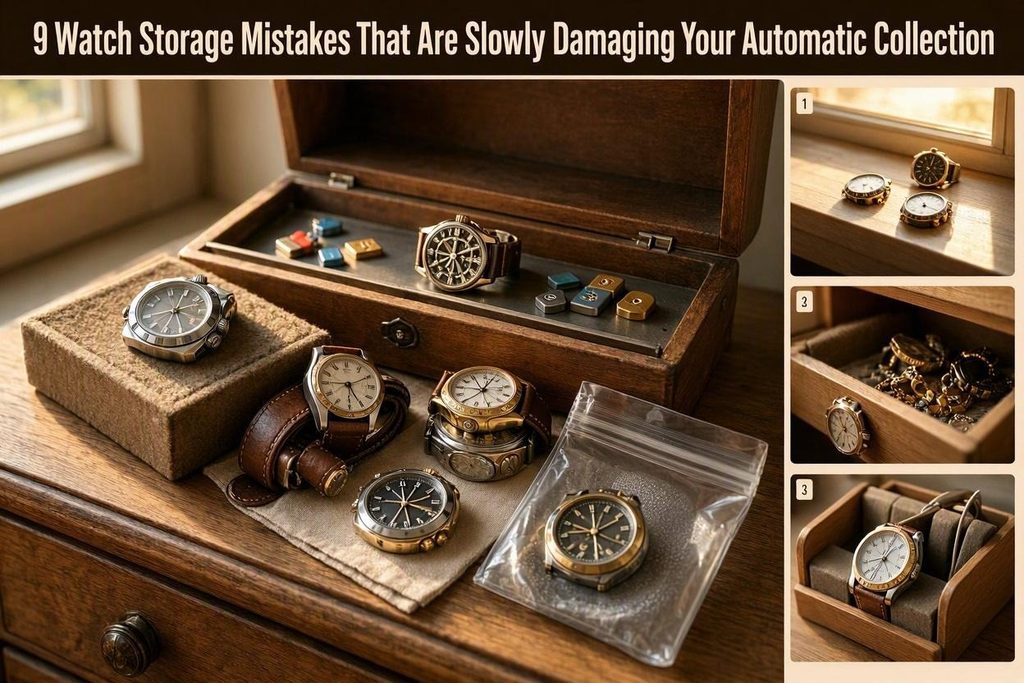
Most watch damage doesn’t happen on the wrist. It happens in the drawer.
A knock against a doorframe or a splash of rain will get noticed and dealt with straight away. Bad storage is quieter. Gaskets dry out, lubricants thicken, movements stop and restart at odd intervals, and by the time you notice something is wrong, the damage has already been building for months. If you own more than one or two automatic watches, how you store them matters almost as much as how you wear them.
Here are nine storage habits that quietly wear down automatic watches, and what to do instead.
1. Leaving Watches to Fully Wind Down Between Wears
An automatic watch that sits untouched for days will run out of power reserve and stop completely. On its own, a single stop-start cycle isn’t a disaster. The problem is repetition. Every time the movement winds down and restarts, the mainspring goes through a full cycle of tension and release, and the date complication (if the watch has one) often has to be dragged through midnight, which puts extra strain on the date-change mechanism.
Collectors who rotate through five or six pieces a week are the most exposed to this, simply because each watch spends most of its time sitting idle. A dive watch worn on Mondays and Fridays, for example, might spend the other five days completely still, which means it’s stopping and restarting almost every single week of the year.
The fix is straightforward: keep frequently worn pieces gently in motion when they’re off the wrist, rather than letting them stop and restart on a loop. It’s a small habit change that adds up to a meaningful difference in wear over several years of ownership.
2. Storing Everything in One Drawer Together
Metal bracelets, especially in gold or with polished links, scratch each other shockingly easily when they’re tossed into the same tray. Crystals pick up hairline marks from clasps and buckles. Leather straps absorb moisture and odour from whatever else is nearby.
A basic principle from Aevitas UK’s own advice for collectors is worth repeating here: watches should never touch each other in storage. Separate slots, cushions, or individual compartments cost very little and prevent damage that’s expensive and sometimes impossible to fully polish out.
3. Ignoring Temperature and Humidity Swings
This is the mistake with the highest long-term cost and the lowest visibility. Movements are precision instruments built from dozens of small metal parts, lubricated with oils that behave very differently depending on temperature. Humidity is worse still, because it’s the single biggest cause of internal corrosion and dial spotting in watches that otherwise look perfectly healthy from the outside.
A watch kept near a window, above a radiator, or in a garage or loft sees far bigger daily swings than most owners realise. Dial finishes can develop spotting, steel components can pit, and lubricants can separate or gum up years before they normally would.
If you’re storing anything beyond a couple of everyday pieces, it’s worth reading this build climate controlled watch explained guide, which walks through practical ways to stabilise temperature and humidity without needing a full safe room.
4. Using a Watch Box With No Cushion Support
Loose cushions inside a watch box aren’t just cosmetic. A case sitting flat against a hard surface, or wedged at an angle, puts uneven pressure on the case back and crown over time, particularly with heavier steel or gold pieces. Cheaper boxes also use cushions sized for one wrist circumference, which forces bracelets to sit unnaturally tight or loose.
Look for cushions that adjust, or that are sized specifically to the case diameter of the watches you own. It’s a small detail that a lot of otherwise good-looking boxes get wrong.
5. Storing Automatics Statically for Long Periods
This is where a lot of collectors get the trade-off backwards. The instinct is to let a watch “rest” when it’s not being worn, on the theory that this reduces wear. In practice, mechanical lubricants are designed to be worked. Oils that sit still for weeks can migrate away from the pivots and jewels that need them, and re-lubrication after long dormancy is often harder on the movement than continuous gentle operation would have been.
This is the exact problem a watch winder is built to solve. Keeping automatics in gentle, continuous rotation means the mainspring stays consistently tensioned, the date function doesn’t need repeated manual correction, and the oils stay distributed the way the manufacturer intended. If you’re weighing up whether a winder is worth it for your collection, you can learn more about the options available before deciding either way.
6. Skipping Regular Case and Crystal Cleaning Before Storage
Dust, skin oils, and everyday grime don’t just sit on the surface. Left on a case back or between lugs for weeks at a time, they can work into gaskets and seals, especially on watches that see any water exposure at all. A soft cloth wipe-down before a watch goes back into storage takes under a minute and meaningfully extends the life of seals and finishes.
This matters more than most owners expect for watches that get worn seasonally, since grime sits undisturbed for months rather than days.
7. Choosing Winder or Box Materials Without Thinking About Long-Term Off-Gassing
Cheap synthetic foams and adhesives used in budget boxes can release volatile compounds over time, particularly in a sealed environment. This is a slower, more subtle version of the humidity problem: it can dull metal finishes and, in rare cases, affect dial lacquer over years of enclosed storage.
Solid wood, genuine leather, and higher-grade synthetics are worth paying for if a piece is going to spend most of its life enclosed rather than on the wrist.
8. Forgetting About Magnetism
Magnetic fields from phone cases, laptop speakers, handbag clasps, and kitchen appliances are one of the most common and least suspected causes of a watch suddenly running fast. A magnetised hairspring can throw a watch off by minutes a day, and most owners never connect the sudden inaccuracy to the phone charger sitting next to the watch box.
Keep storage areas away from speakers, magnetic cabinet latches, and charging pads, and if a watch starts gaining time out of nowhere, magnetism is one of the first things worth ruling out. A watchmaker can usually demagnetise an affected movement in a few minutes, but it’s a needless repair trip that’s easy to avoid by simply thinking about where a box sits relative to everyday electronics.
9. Treating Storage as an Afterthought Rather Than Part of Ownership
The single biggest mistake isn’t any one habit on this list. It’s treating storage as something to sort out eventually, after the watch itself is bought. A £3,000 watch kept in a £10 drawer tray is exposed to every problem above at once.
Collectors who get the most longevity out of their pieces tend to think about storage at the same time they think about the purchase itself, not months or years afterward. Retailers who specialise in accessories built specifically for watch collections, such as the official Aevitas UK site, generally build their ranges around exactly these failure points, since they see the same damage patterns come up again and again from customers.
Final Thoughts
None of these mistakes are dramatic on their own, which is precisely why they’re so common. Nobody drops a watch into a drawer intending to damage it. The wear happens gradually, through small daily choices about where a watch sits and how it’s treated when it’s not being worn.
The good news is that fixing all nine issues doesn’t require an expensive overhaul. A well-cushioned box, a stable spot away from windows and radiators, some basic distance from magnets, and a winder for pieces that would otherwise sit idle will cover most of what’s on this list. For anyone building this out step by step, it’s worth understanding how an automatic movement actually works in a bit more depth, since the mechanics behind winding and power reserve make the reasoning behind all of this click into place.
FAQs
Do I need a watch winder if I only own one automatic watch? Not necessarily. If you wear it most days, manual winding or wrist motion will keep it running fine. A winder becomes genuinely useful once a watch sits unworn for more than a few days at a stretch, or once you own several automatics and rotate between them.
How often should automatic watches be serviced if stored properly? Good storage doesn’t remove the need for servicing, but it does stretch out the interval in which problems appear. Most manufacturers still recommend a full service every three to five years regardless of storage conditions.
What humidity level is actually safe for watch storage? Most horologists point to somewhere between 40% and 55% relative humidity as the safe range, with sudden swings being more damaging than a slightly high or low but stable reading.
Can a watch winder overwind a mainspring? No. Modern automatic movements include a slipping clutch mechanism specifically to prevent overwinding, whether the energy comes from a winder or normal wrist movement.
Is it bad to store watches in direct sunlight? Yes, on two fronts. UV exposure fades dial colours and ages leather straps unevenly, and direct sun also raises the local temperature around the watch far more than most people expect, compounding the humidity and heat issues covered above.