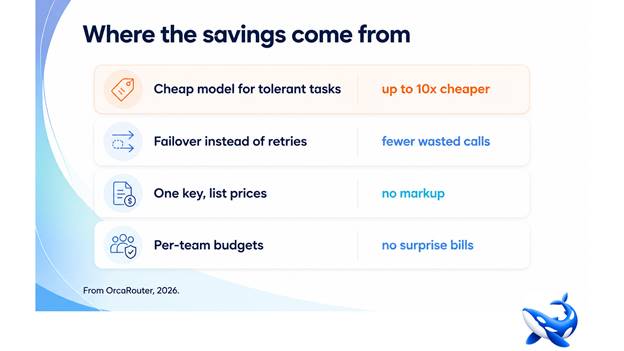
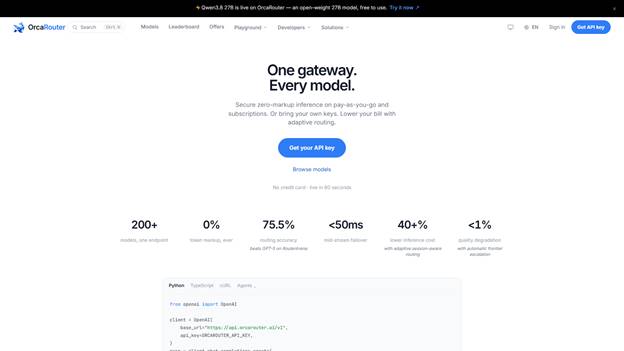
LLM bills grow in the places you do not think about: every retry, every over-provisioned model, every call that could have used the cheap option. An AI router attacks all of them at once, because cost control is not a feature of a router — it is the point. OrcaRouter is one platform built around this pattern; here are the specific rules that actually move the bill.
Rule one: cheap model for tolerant work
The biggest single saving. Most production calls do not need the frontier model: extraction, classification, summarising supplied text, format conversion, routing, first-pass filtering. These tasks are tolerant — the cheapest model in the pool that can do them is usually fine.
A router’s “cheapest first” rule sends those calls to the economical model and only escalates to a stronger one when the task actually needs it or when a configured capability threshold says so. On a workload where 60% of calls are tolerant, that rule alone can cut the model spend on those calls by an order of magnitude.
Rule two: failover instead of retries
When a provider is down or rate-limited, applications without a router do one of two things: surface an error to the user, or retry the same provider — paying for the failure again. A router fails over to a healthy alternative automatically. The request still completes, at the backup model’s price, and your availability story stops depending on any single vendor.
Retries are a hidden line item in most LLM budgets. Eliminating the retry loop is not just a reliability win; it is a cost win.
Rule three: one key, list prices
Integrating models directly usually means paying a markup somewhere — either a per-token surcharge or a middleman margin. An AI router that passes vendor list prices through with zero markup means the model you are routed to costs what the vendor charges, not what a reseller adds. And one API key for the whole pool replaces the administrative overhead of five vendor accounts, five keys, five rate-limit conversations.
Rule four: per-team budgets and limits
Cost control is also governance. A router can carry per-team budgets, per-project limits, and hard caps. When a team’s spend hits its ceiling, the router can downgrade to a cheaper model rather than cut the service, or block and log. That turns “where did this bill come from” into a per-team report, and it prevents the single worst budget event — the surprise.
What the savings actually look like
There is no universal number, because the mix of tolerant and hard work varies. But the shape is consistent: tolerant-call savings come from the cheap-first rule and are the largest line; failover savings come from fewer wasted calls; no-markup savings come from list-price pass-through; governance savings come from budgets that stop runaway spend. Teams that adopt a router usually find the savings in the first two, then keep the other two as the discipline that prevents regressions.
The measurement that proves it
The honest way to prove the savings is to measure them. Before adopting a router, record per-task-type spend for a week; after, do the same. The before-and-after shows exactly which rule produced which saving — the cheap-first rule on extraction, the failover rule on retry waste, the budgets on the runaway line. Teams that skip this measurement tend to believe the router “saved nothing” because they never configured the rules; teams that measure usually find the savings concentrated in the first rule and then extend it. Cost control without measurement is a belief; with it, it is a number you can defend.
Where the numbers land
The savings are not uniform, and being specific about that is the honest part. A system whose calls are 90 percent frontier-needing saves little on the cheap-first rule. A system with a normal mix — some extraction, some summarisation, some hard reasoning — usually finds that the tolerant majority is where the money goes. The reliable wins are the ones that come from structure rather than rates: no retry waste, no markup, no surprise bill. Those four are true for every workload, while the cheap-first saving varies with the mix. Plan for the structural savings and measure the tolerant-call savings, and you will have a cost story that survives contact with a real invoice.
The takeaway
An AI router cuts your LLM bill with four rules: cheap-first for tolerant work, failover instead of retries, one key at list prices with no markup, and per-team budgets with hard caps. None of them requires believing the frontier model is overpriced — they only require that you stop paying frontier prices for work that does not need them. The savings compound because each rule removes a different kind of waste, and they come as a configuration rather than a rewrite.
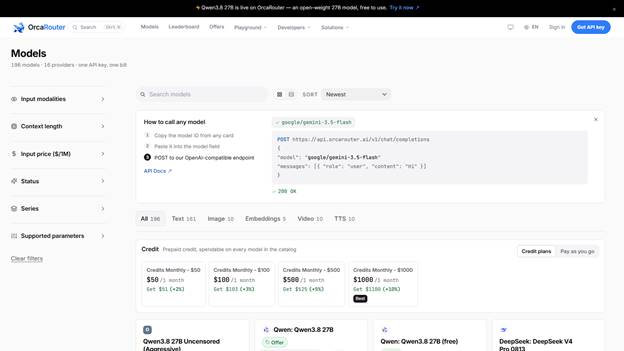
Sourcing note: this article describes the AI-router category and OrcaRouter’s implementation. List-price pass-through with no markup, automatic failover, per-team budgets and the routing rules are OrcaRouter’s own published descriptions, checked August 2026.