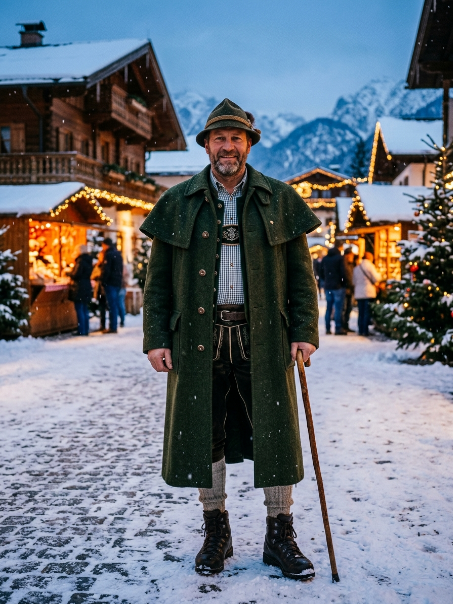
Bavarian dressing does not end when the beer tents close the calendar simply moves outdoors and gets colder. Christmas markets, winter festivals, Alpine church processions, and late-autumn hunting-season gatherings all keep traditional wardrobes working through the year’s coldest months, and the trachten coat is the garment that makes it possible. Longer and warmer than the festival Janker, the traditional coat family — led by the legendary loden Mantel — carries full Bavarian character into genuinely cold weather, layering over lederhosen and dirndl alike without burying their detail. For anyone whose Bavarian calendar extends past October, the coat is not a luxury addition; it is the piece the winter half of the tradition is built around.
This guide covers the coat styles, the loden standard that defines them, the layering rules over traditional dress, and the buying logic for the 2026 cold season.
The Coat Family: Mantel, Hunting Coats, and Long Janker
The Trachten coat category spans three recognizable forms. The loden Mantel is the icon: a long, deep-green (or gray) wool overcoat, often with the distinctive back cape or inverted pleat that sheds rain off the shoulders — Alpine engineering that became international elegance. The hunting-style coat runs shorter and more rugged, in forest green and brown loden with horn buttons and generous pockets, descended directly from Alpine forestry wear. The long Janker splits the difference: the familiar Janker silhouette extended toward mid-thigh for more coverage while keeping the jacket’s trim character.
Colorways stay within the traditional palette — loden green above all, then gray, brown, and charcoal — and the green Mantel in particular remains the single most recognizable piece of cold-weather Alpine dress in the world.
Loden in Winter Weight: Why the Fabric Rules the Season
Everything the coat family promises rests on winter-weight loden — the dense, felted, brushed Alpine wool that mountain weather spent centuries refining. In coat weights, loden delivers serious cold protection without down-jacket bulk, natural resistance to rain and snow that keeps outdoor market evenings comfortable, wind-blocking density from the felted weave, and the matte, deep color that photographs beautifully against winter light and market glow.
The imitation tier — polyester “wool-touch” coats and acrylic blends — fails exactly where winter tests hardest: soak-through, wind cut, pilling, and plastic shine in photos. Genuine loden or stated high-wool content is the non-negotiable screen, with honest 2026 coat pricing at roughly $150 to $280 accessible and $280 to $500 for premium Mantel and detailed hunting versions.
Layering Over Traditional Dress: The Rules That Matter
The coat’s defining skill is layering over full traditional outfits without erasing them, and two rules govern it. Over lederhosen ensembles, the coat stays open whenever conditions allow, keeping suspenders and leather visible; when buttoned against real cold, kniebund-length lederhosen and wool knee socks keep the traditional silhouette legible below the hem. Over dirndl, coat length should clear the dirndl hem or sit well above it — a coat ending mid-skirt cuts the dress awkwardly — and the classic pairing of long green Mantel over a wool winter dirndl remains the definitive Christmas-market look.
Underneath, winter Tracht adjusts with the season: long-sleeved Trachtenhemd or blouse, wool vest or cardigan as a mid-layer, wool socks and weather-worthy Haferl-style shoes or boots. The coat completes a system rather than replacing it.
Where the Coat Carries Traditional Bavarian Wear
The cold-season calendar is where the coat earns its keep, because traditional bavarian wear genuinely lives outdoors in winter. Christkindlmarkt evenings across Germany and their American counterparts run for weeks of sub-freezing outdoor socializing. Winter Volksfeste, Epiphany and church processions, Alpine ski-town festivals, and hunting-season gatherings all expect traditional dress that can stand hours of cold. A festival-weight Janker manages an October evening; the coat family is what makes January participation comfortable rather than heroic.
The crossover dividend runs even stronger in winter than in autumn: a loden Mantel over an ordinary sweater and trousers is simply a distinguished winter coat anywhere on earth, which means the purchase works every cold day of the year, Bavarian calendar or not.
Fit Notes for Coats Over Tracht
Coat fit follows outerwear logic with Tracht adjustments. Size to layer: the chest and shoulders must accommodate shirt plus vest or cardigan beneath without strain — one size up from a bare-torso fit is common. Shoulder seams still sit at the shoulder edge; the cape-back Mantel adds natural room through the upper back. Length is a register choice: mid-thigh long-Janker for active outdoor events, knee-length or below for maximum warmth and formality. Sleeves end at the wrist with room for a sweater cuff beneath.
Buying for the 2026 Cold Season
Coat timing runs opposite to festival timing: demand peaks from October into December as market season opens, and popular Mantel sizes thin by November. Ordering in early autumn secures selection; ordering in summer alongside festival pieces is the veteran move that beats both rushes. Care mirrors all loden — brush, air, spot-clean, rare dry cleaning, cedar-protected hanging storage through the off-season — and rewards it with the multi-decade lifespan that makes inherited loden coats a Bavarian family commonplace.
Frequently Asked Questions
What distinguishes a Trachten coat from a Janker?
Length and weight — the coat family runs mid-thigh to below-knee in winter-weight loden, built for genuinely cold outdoor hours; the Janker is the shorter festival-weight jacket.
Which style should I buy first?
Market and city use: the classic green loden Mantel. Rugged outdoor and hunting-register use: the shorter hunting-style coat.
Can it be worn over a dirndl?
Yes — keep the coat hem clear of the dirndl hem, and pair the long Mantel with winter-weight dirndl for the classic Christmas-market look.
What should genuine quality cost in 2026?
Roughly $150 to $280 accessible loden tiers; $280 to $500 for premium Mantel and detailed versions.
How warm is loden really?
Winter-weight loden handles sub-freezing outdoor evenings comfortably with proper layering — it was engineered for Alpine winters.
When should I order?
Early autumn at the latest; popular coat sizes sell through by November as market season peaks.