How to Stop Your Game Levels From Feeling Repetitive
You build a game with multiple levels, but after the first few, everything looks and plays the same. Platforms spaced the same way, enemies in the same spots, backgrounds that barely change. Players notice quickly, they beat level 2 like level 1, then level 3 feels like a copy. Boredom sets in and they stop playing halfway through.
This repetition happens because basic descriptions repeat patterns without specific instructions for change. The tool creates consistent levels, but without variety the game drags instead of exciting. Variety keeps players hooked by making each level feel fresh while building on what they already know. You add it through small description tweaks, different obstacles, themes, pacing, or surprises.
Why Repetition Makes Levels Boring Fast
Levels feel repetitive when core elements stay identical across the game. Same jump height needed everywhere, enemies attacking the same way, collectibles sitting in predictable lines. Players learn the pattern once and autopilot through the rest, no challenge, no thrill. Without changes, skill stops growing and wins feel automatic.
The root cause is vague descriptions like make 10 levels with platforms and enemies. The tool repeats safely when given nothing specific to vary. Fix this by planning progression deliberately. Early levels teach basics, middle levels add twists, and late levels ramp difficulty with new combinations.
Variety builds tension where players think what’s next instead of this again. Test by playing levels 1, 5, and 10. Do they feel distinct? If not, repetition is ruling your game.
Plan Level Progression Before Building
Start with a simple outline of 8 to 12 levels grouped in threes. Levels 1 to 3 teach core jumps and collection. Levels 4 to 6 introduce new obstacle types. Levels 7 to 9 mix everything at a higher speed. Levels 10 to 12 combine all mechanics with a boss encounter or speed challenge finale.
This arc feels complete, easy start, building middle, tough end. Describe progression explicitly. Levels 1 to 3 use basic platforms and slow enemies. Levels 4 to 6 add moving platforms and flying foes. Levels 7 and beyond speed up and mix all types.
Generate the full set and play sequentially. If level 4 feels too similar to level 3, add one unique element like wind pushing the player sideways. Progression turns repetition into growth, making every win feel genuinely earned.
Change Obstacles and Layouts for Fresh Challenges
Obstacles drive how a level feels to play. Repeating the same spikes or gaps bores players quickly, while variety tests different skills and keeps adaptation alive.
Practical ways to vary obstacles without overcomplicating your descriptions include moving from static to dynamic, where levels 1 to 3 use fixed platforms and levels 4 to 6 add platforms moving up and down. Spacing shifts work well too, with wide gaps early for comfortable jumps and narrower gaps later requiring precise double jumps. Rotate obstacle types so spikes appear at ground level in level 1, ceiling level in level 4, and protruding from walls in level 7. Then combine them in level 10 for a puzzle like feel that demands both timing and planning.
Play each version and ask yourself whether level 4 demands different timing than level 3. Variety forces adaptation, which is exactly what keeps engagement high.
Switch Visual Themes and Backgrounds
The same background across every level blends them in the player’s memory. New themes refresh the eyes and can directly reinforce the mechanics, such as icy surfaces in a snow level that cause sliding.
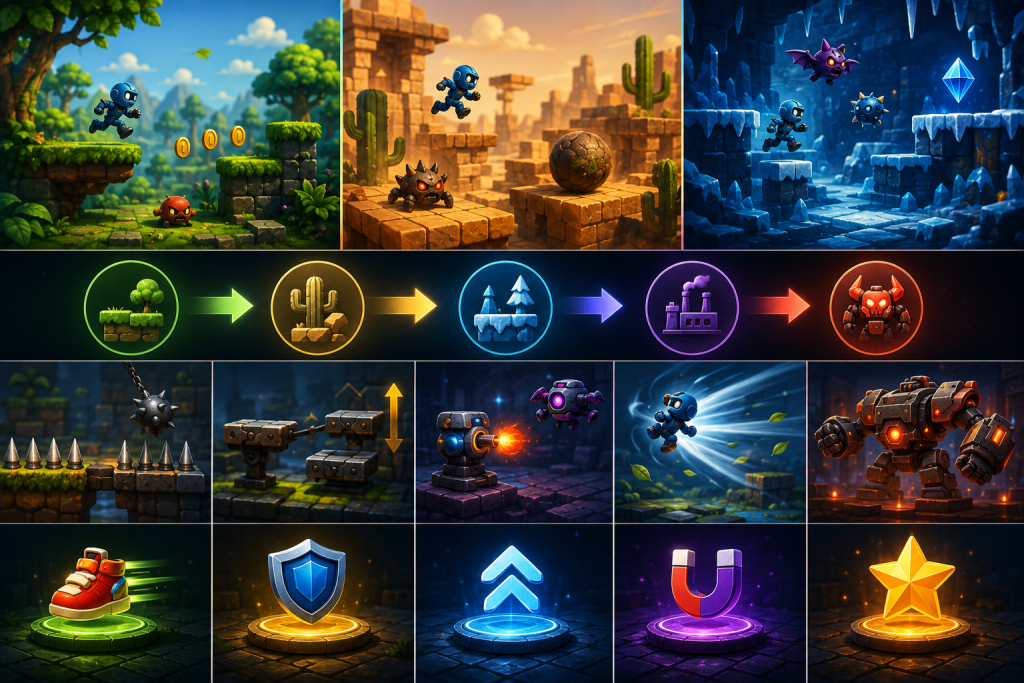
Vary themes progressively across your level groups. Levels 1 to 3 can use a forest setting with green platforms, leaves drifting slowly, and calm music. Levels 4 to 6 can shift to desert dunes with rolling boulders and a tense percussive soundtrack. Levels 7 to 9 work well in a dark cave with glowing crystals marking safe paths. Levels 10 and beyond can move to an industrial factory with conveyor belts and a mechanical rhythmic soundtrack.
Describe each theme as changing colors, particle effects, and music tempo together so the shift feels complete rather than cosmetic. Run the full game from start to finish and check whether the themes make individual levels memorable.
Introduce New Enemy Behaviors and Power Ups
Enemies that repeat the same attack pattern become invisible to experienced players. Variety in movement and abilities keeps every encounter requiring attention.
Evolve enemy types across level groups. Levels 1 to 3 use basic walkers that charge straight ahead. Levels 4 to 6 introduce jumpers that hop over platforms to close the distance. Levels 7 to 9 bring in shooters that fire slow projectiles the player must dodge. Levels 10 and beyond feature swarms that attack simultaneously from multiple directions.
Pair enemy upgrades with matching power ups, such as a speed boost in early levels, a shield that blocks one projectile in mid game, and a double jump in later stages. Play boss levels specifically and check whether the new enemy behaviors force a genuinely different strategy.
Mix Pacing and Length for Dynamic Flow
Every level running the same length at the same speed is one of the most common causes of fatigue in player made games. Short fast levels and long thoughtful ones create a natural rhythm.
Levels 1 to 3 work best at medium length with a slow pace that gives room to learn mechanics without pressure. Levels 4 to 6 can be short bursts at high speed with minimal platforming complexity. Levels 7 to 9 benefit from being longer with deliberate breaks and puzzle sections between action sequences. Levels 10 and beyond can use quick escalating waves that combine all previous mechanics rapidly.
Test by running the entire game in one sitting. Does your energy and attention stay consistent throughout? Pacing variety prevents the mental fatigue that makes players quit before the final levels.
Test Variety Through Full Playthroughs
Variety only proves itself in sequence. Testing individual levels in isolation misses how they blend over time.
Run through all levels straight through three times in a row, noting any moments that feel similar. Time each level individually and check that durations and themes are genuinely distinct. Have a friend play and ask them afterward which levels stood out and why, without prompting them. Regenerate after each individual tweak and compare before and after rather than changing multiple things simultaneously.
Aim for 80 percent of levels to feel unique when played back to back. If a friend cannot recall a specific level as distinct from its neighbors, that level needs one more meaningful change before the game is ready to share.
See It Done Right
To see what well executed level variety looks and feels like in a finished game, play 99 Days in Space. It demonstrates how progressive theme changes, escalating obstacles, and shifting pacing come together to keep players engaged from the first level to the last without the repetition that causes most player made games to lose their audience halfway through.
Share and Refine Based on Player Feedback
Once published, track which levels players drop off at, since those data points point directly to where repetition crept back in. Comments will highlight specific moments that felt too familiar. Tweak underperforming levels one element at a time and republish.
Variety transforms games from things people try into things people finish. Outline your progression in three groups, describe the differences explicitly, generate the full set, and play the whole thing through. Feel where freshness holds and where it slips. Repeat the tweak cycle until players reach the end saying it felt different and exciting the whole way through.
Whether you are building your first project or improving an existing one, Astrocade gives you the tools to create, test, and publish levels that stay fresh from start to finish.