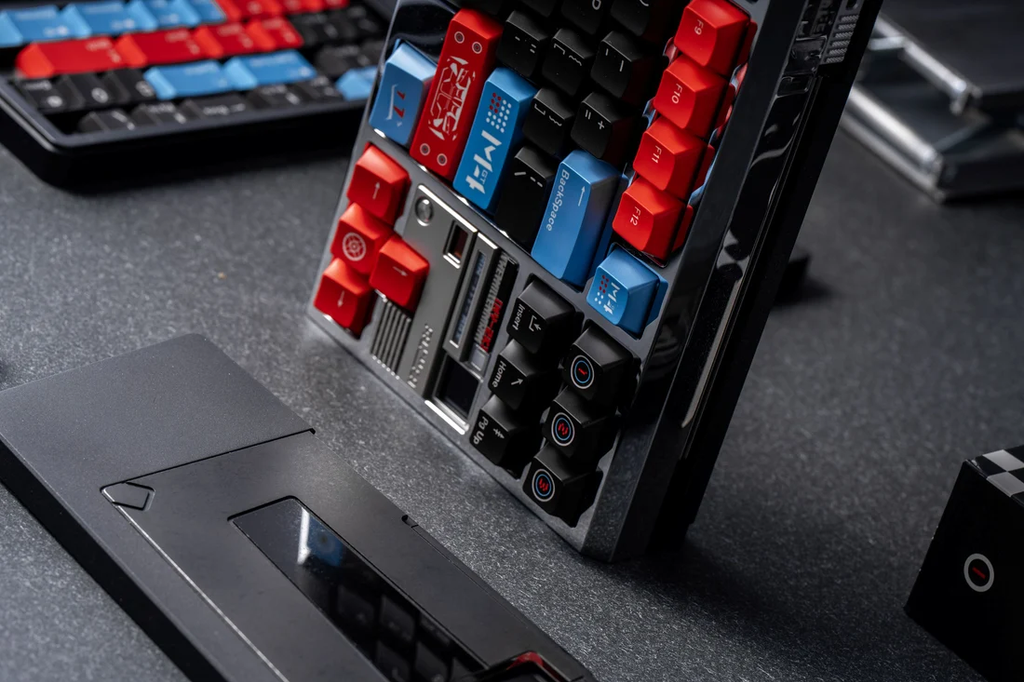
Two PBT keycap sets may use the same plastic but differ significantly in legend method, height, feel, and keyboard compatibility. Dye-sublimated legends and double-shot construction are both established choices; the right one depends on the design and lighting you want.
Compatibility deserves equal attention. A keycap set can fit MX-style stems and still lack the unusual right Shift, bottom-row, or spacebar sizes required by your keyboard. To compare layout coverage and legend methods, browse pbt keycaps and review each set’s compatibility diagram.
UniKeys’ catalog provides concrete examples: UniKeys Mai Lang is dye-sublimated PBT in Cherry profile, and TUT C.C.C.C specifies five-sided dye-sublimation and 1.6 mm thickness. Compare the actual construction and included keys before choosing a finish.[UK1]
What Should You Look for When Buying PBT Keycaps
Before choosing a color scheme or design, consider the material, profile, and construction of the keycaps. These factors help determine whether a set suits your typing habits, keyboard, and budget.
How Important Is Keycap Material Quality
PBT, or polybutylene terephthalate, is a thermoplastic commonly used in mechanical keyboard keycaps. Compared with ABS, another widely used keycap plastic, PBT generally offers better resistance to surface wear and the glossy appearance that can develop with prolonged use. It often has a slightly textured feel, although the exact finish depends on manufacturing and surface treatment. Material quality and molding consistency still matter, so PBT alone does not guarantee a premium product.
Which Keycap Profile Should You Choose
Keycap profile describes the shape and height of the keys. OEM and Cherry profiles are common choices for everyday typing, while SA keycaps have a taller, more sculpted design. DSA and XDA profiles offer a more uniform appearance across the keyboard. Your preferred typing posture, finger movement, and familiarity with a particular keyboard all influence which profile feels comfortable.
Why Do Keycap Thickness and Construction Matter
Thickness can affect rigidity and resonance, but a thicker cap does not guarantee a deeper sound. TUT C.C.C.C lists 1.6 mm thickness, while Monster Lab Carnival lists 1.7 mm; evaluate molding, fit, finish, and the complete keyboard alongside those numbers.
What Are the Different Types of PBT Keycap Printing Methods
The printing method determines how letters, numbers, and symbols are formed on a keycap. Two common options are dye-sublimation and double-shot molding. Both can provide long-lasting legends, but they use different manufacturing processes and offer different design possibilities.
What Are Dye Sublimated PBT Keycaps
Dye-sublimation uses heat to transfer dye into the surface layer of the keycap material. Instead of simply placing a printed layer on top, the process allows the color to penetrate the plastic.
Monster Lab Carnival is a Cherry-profile PBT example with five-sided dye-sublimation and a Soft Metallic Finish; its novelty caps are PC. Review the actual design, mixed materials, and care guidance rather than assuming every keycap in the kit has the same construction.
What Are Double Shot PBT Keycaps
Double-shot keycaps are manufactured by molding two plastic components together. One forms the legend, while the other forms the surrounding keycap body. When produced correctly, the legend is part of the keycap structure rather than a surface coating.
Double-shot construction makes the legend a molded component, but it does not identify the body plastic or guarantee backlighting. KEYKOBO Cherries is a UniKeys example made from double-shot ABS, not PBT. For any PBT double-shot set, verify the stated materials and shine-through support on that exact listing.
Which Printing Method Offers Better Legend Durability
Both dye-sublimation and double-shot molding can offer good legend durability. The better choice depends on your priorities rather than a universal ranking.
| Feature | Dye-sublimated PBT | Double-shot PBT |
| Legend construction | Dye penetrates the plastic surface | Separate molded plastic forms the legend |
| Legend wear | Generally resistant to normal surface wear | Legends are integrated into the keycap structure |
| Design options | Detailed designs and varied typography | Strong color contrast and molded legends |
| Backlighting | Usually not shine-through | Possible with translucent legend material |
| Best suited for | Decorative designs and non-backlit keyboards | Long-term legend visibility and selected backlit setups |
For example, someone who types all day in an office may prefer dye-sublimated keycaps with clear, high-contrast legends. A gamer who relies on illuminated keys may prefer a double-shot set specifically designed for backlighting.
Regardless of the method, inspect the legend sharpness, alignment, and contrast. Manufacturing quality can matter as much as the printing method itself.
Which PBT Keycap Profile Is Right for You
Profile affects the height, shape, and arrangement of keycaps. Some profiles have different heights across each row, while others use a more uniform design. There is no single profile that works best for every keyboard user.
What Are OEM and Cherry Keycap Profiles
OEM and Cherry are two common sculpted profiles. OEM keycaps are widely used on prebuilt mechanical keyboards and are familiar to many users. Cherry profile is generally lower, with row-specific shapes designed to follow the natural arrangement of the keyboard.
Both can work well for everyday typing, gaming, and office tasks. However, their exact dimensions vary by manufacturer. If you are replacing the keycaps on a low-profile or compact keyboard, confirm the original keycap height and switch clearance before ordering.
How Do SA DSA and XDA Profiles Differ
SA keycaps are tall and sculpted, creating a distinctive retro appearance and a more pronounced shape beneath the fingers. Some users enjoy their substantial feel, while others need time to adjust.
DSA keycaps are relatively short and uniform in shape across the rows. XDA keycaps also have a relatively uniform row profile, with a broad top surface that creates a different typing feel. These designs can appeal to people who prefer a consistent visual layout or want to customize their keyboard with colorful sets.
| Profile | General design | Considerations |
| OEM | Medium-height, sculpted rows | Familiar choice for many standard keyboards |
| Cherry | Lower sculpted rows | Check compatibility with unusual switch or keyboard configurations |
| SA | Tall, sculpted rows | Distinctive appearance; may require an adjustment period |
| DSA | Short, uniform rows | Consistent height across rows |
| XDA | Uniform rows with broad tops | Flat-looking layout and a spacious keycap appearance |
Which Profile Is Suitable for Gaming and Everyday Typing
For everyday work, OEM or Cherry profiles are practical starting points because they are familiar and widely available. Gamers may also prefer these profiles because they resemble the layouts used on many standard mechanical keyboards.
SA can appeal to users who value aesthetics and a taller typing feel, while DSA and XDA may suit those who prefer uniform rows. None of these profiles automatically improves typing speed or gaming performance. If possible, test a similar profile before purchasing a full set, especially if you spend several hours a day at your keyboard.
How Do You Check PBT Keycap Compatibility
A keycap set can have the right material, profile, and color scheme but still fail to fit your keyboard properly. Before purchasing, check the keyboard layout, individual key sizes, switch stem design, and any special clearance requirements.
How Do You Check Your Keyboard Layout and Key Sizes
Start by identifying your keyboard size, such as full-size, tenkeyless (TKL), 75%, 65%, or 60%. Smaller keyboards may use nonstandard bottom-row keys or omit certain keys entirely.
Next, check the size of individual keys. Most standard alphanumeric keys use a 1u size, while the spacebar, Shift, Enter, and other modifier keys may be wider. A 1u key is the reference width of a standard key; larger keys are measured in multiples of that unit.
TUT C.C.C.C lists several layout sizes, including 65% and 75%. Still compare its kit diagram with your exact right Shift, bottom row, spacebar, and arrow-cluster keys. A listed layout category does not guarantee every variation.
Are PBT Keycaps Compatible With Different Mechanical Switches
Many aftermarket PBT keycaps use a cross-shaped stem compatible with Cherry MX-style switches and numerous compatible designs. However, not every mechanical keyboard uses the same mounting system.
Low-profile mechanical switches, optical switches, and proprietary switch designs may require dedicated keycaps. Even when the stem fits, the keycap’s underside can interfere with nearby components or fail to provide adequate clearance.
Confirm stem fit and switch clearance using the actual keyboard and keycap specifications. UniKeys Mai Lang and the other Cherry-profile examples here should not be assumed compatible with proprietary or low-profile systems solely because of their material.
What Should You Know About ANSI and ISO Layouts
ANSI and ISO layouts differ in key arrangement and physical dimensions. ANSI keyboards commonly have a horizontal Enter key and a longer left Shift key. ISO keyboards typically have a taller, angled Enter key and a shorter left Shift key, with an additional key near the left Shift area.
These differences affect the number and shape of keycaps you need. A set designed only for ANSI may not include the correct ISO Enter key or additional keys. If you use a UK or European keyboard layout, verify ISO support and the availability of your required language legends before ordering.
Once you have confirmed layout, stem compatibility, and profile, compare the exact keys included in each kit.
PBT Keycap Compatibility and Legend Checklist
• Check the keycap profile (Cherry, OEM, SA, DSA, or XDA) and whether the row shapes work with your layout.
• Check whether legends are dye-sublimated or double-shot; verify shine-through independently of the manufacturing label.
• Confirm MX-style stem fit as well as the exact key sizes for your ANSI, ISO, or custom layout.
• Review the kit contents, especially spacebars and modifiers, instead of assuming a photographed keyboard indicates included compatibility.
Conclusion
A well-chosen PBT set combines sound molding quality with the legend method, profile, and key coverage your keyboard requires.
Before choosing a design, verify the layout diagram and product specification. These details have a bigger effect on successful installation than promotional descriptions of “premium” keycap material.
FAQs
Are All PBT Keycaps Compatible With Cherry MX Style Switches
No. Many PBT keycap sets use a cross-shaped stem designed for Cherry MX-style switches, but some keyboards use low-profile, optical, or proprietary mounting systems. Check the switch specifications and the keycap manufacturer’s compatibility information before ordering.
Are Double Shot PBT Keycaps Better Than Dye Sublimated Keycaps
Neither method is universally better. Double-shot molding creates legends from a separate piece of plastic and can support shine-through designs when translucent materials are used. Dye-sublimation transfers dye into the keycap surface and is popular for detailed, durable designs. Your preferred appearance, lighting needs, and product quality should guide the decision.
How Often Should You Replace PBT Keycaps
There is no fixed replacement schedule. Quality PBT keycaps can remain usable for years, depending on manufacturing quality, frequency of use, cleaning habits, and environmental conditions. Replace individual keycaps or the full set when you notice damage, poor fit, fading legends, or a change in feel that affects your typing experience.
Catalog review: Added process, profile, thickness and compatibility examples from the actual catalog. Disclosed Carnival PC novelties and separated double-shot from PBT material.